
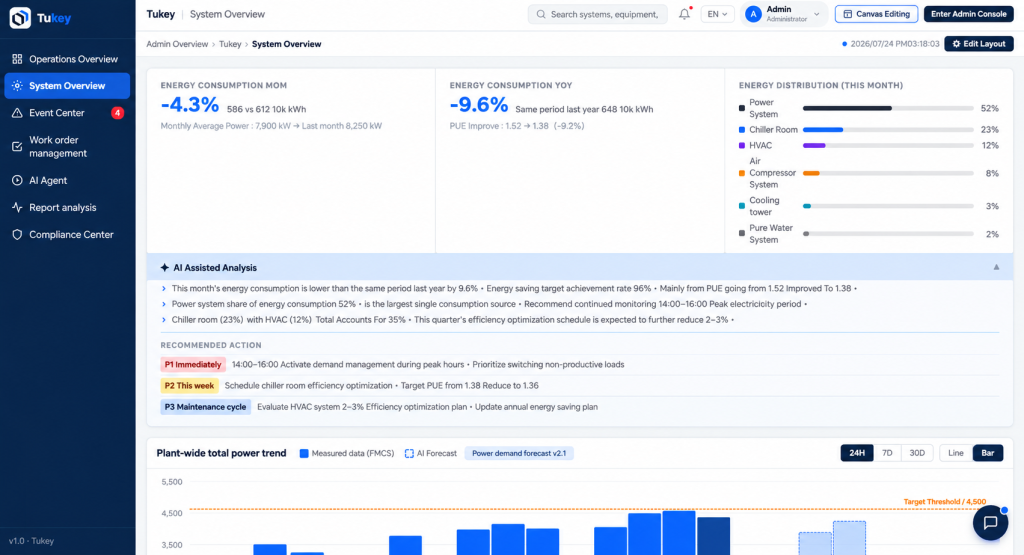
Chimes AI, an industrial AI startup, leverages FPT AI Factory to accelerate generative AI capabilities on its Tukey platform, helping manufacturers quickly detect anomalies, analyze root causes, and receive maintenance recommendations.
As large language model (LLM) inference, long-context processing, and retrieval-augmented generation (RAG) become increasingly complex, the previous GPU environment has begun to limit performance. With NVIDIA H100 GPU Cloud infrastructure, Chimes AI achieved nearly 3× faster inference, enabling Tukey to retrieve information, respond to queries, and analyze data faster with AI.
From Predictive AI to Actionable Industrial Intelligence
Chimes AI developed Tukey, an industrial AI platform designed for use cases such as equipment health management, operational parameter optimization, and product quality prediction. In traditional systems, machine learning can detect anomalies or predict potential equipment failures, but engineers must still identify root causes, consult operating procedures, review maintenance history, and determine appropriate corrective actions.
Chimes AI addresses this gap by combining machine learning and generative AI in a unified workflow. Machine learning detects anomalies and predicts potential issues, while generative AI helps interpret results, analyze root causes, retrieve operating procedures and maintenance records, and recommend priority actions. This approach enables engineering teams to quickly identify where a problem lies, what caused it, and how the system should be addressed.
Accelerate Faster Inference Through Expanded Computing Capacity
Expanding Tukey’s capabilities with generative AI also increases its computing requirements. LLM inference, RAG, and long-context processing require sufficient GPU performance to deliver responsive results in production environments.
In its previous PRO5000 GPU environment, Chimes AI faced limitations when running large models, particularly for RAG and long-context processing. High latency affected how quickly the platform could deliver analysis and recommendations to operations teams.
With NVIDIA H100 GPU VMs on FPT AI Factory, Chimes AI deployed Qwen3.6-27B using vLLM on a computing environment better suited to performance-intensive AI inference workloads. In a benchmark using 2K input tokens, end-to-end latency decreased from 9.54 seconds to 3.28 seconds, representing an approximately 2.9× improvement over the previous environment.
The improved performance enables Chimes AI to further develop RAG capabilities, AI-assisted analysis, and next-generation industrial generative AI services. In production environments, faster processing also allows engineering teams to access analytical insights and recommendations sooner, helping them proactively address potential issues.
According to Chimes AI, its industrial AI solution achieves over 90% anomaly detection accuracy, reduces unplanned downtime by up to 30%, and cuts staff time spent on maintenance activities by up to 50%.
“FPT AI Factory delivered a smooth, low-latency AI inference experience that met our performance expectations while providing a solid foundation for the development of its next generation of Industrial GenAI services”, said Dora Hsieh, Executive Assistant to the CEO at Chimes AI.
With the computing infrastructure provided by FPT AI Factory, Chimes AI continues to evolve Tukey beyond predictive AI toward a system that supports enterprises throughout the process of detection, analysis, recommendation, and action.