
The inference workloads have changed. Reasoning models generate long internal traces. Coding agents repeatedly read repositories, tool outputs, and execution logs. Enterprise RAG systems retain large documents and conversation histories.
Under these conditions, GPU performance is judged not only by matrix-multiplication speed, but by how efficiently it moves weights and KV-cache data, how many requests it holds in memory, and how many GPUs each model replica requires.
NVIDIA HGX B300 changes the architecture.
1. The Hardware Gap Behind NVIDIA B300’s Outperformance
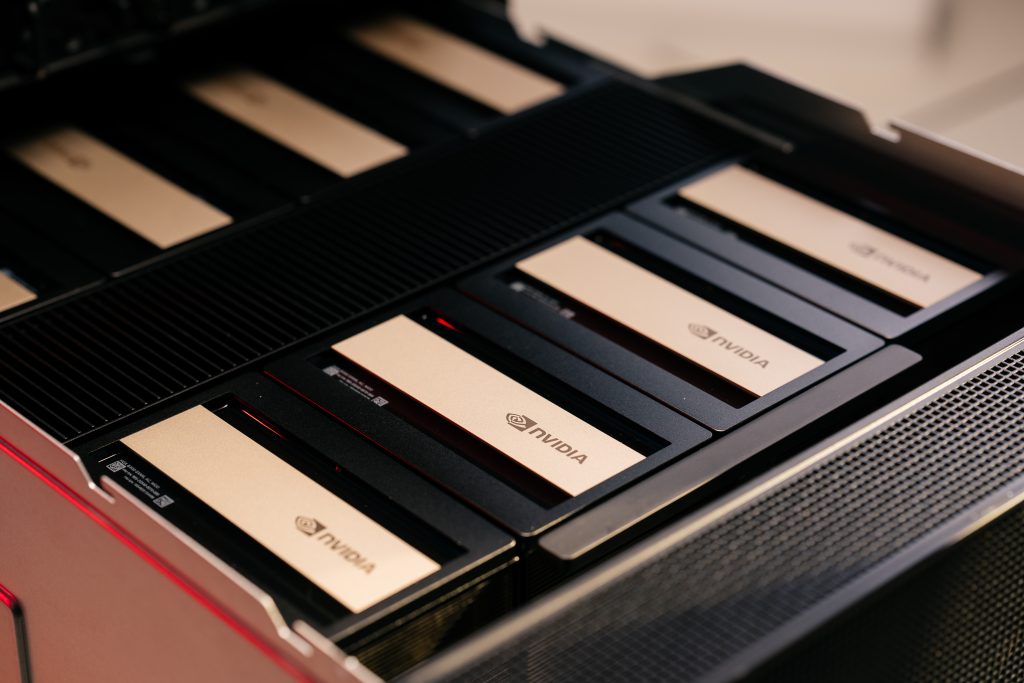
NVIDIA HGX B300 provides more than 2× the memory capacity, approximately 1.67× the memory bandwidth, and 2× the NVLink bandwidth of H200. An 8-GPU DGX B300 system provides 2.1 TB of total GPU memory, 144 PFLOPS of FP4 Tensor Core performance, and 14.4 TB/s of aggregate NVLink bandwidth.
| Capability | NVIDIA H200 SXM | NVIDIA B300 SXM |
| GPU memory | 141 GB HBM3e | 288 GB HBM3e |
| Memory bandwidth | 4.8 TB/s | 8 TB/s |
| Low-precision compute | FP8 | NVFP4 and FP8 |
| NVLink bandwidth | 900 GB/s | 1.8 TB/s |
Source: NVIDIA
These upgrades target the three constraints that dominate LLM serving: fitting the model, feeding the compute units, and synchronizing GPUs.
2. Agentic Specific & Long Context Benchmark for NVIDIA HGX B300
GLM-5.2 Agentic Throughput at 100K Context (Standalone, HGX B300)
Production-like agentic and long-context workloads exhibited greater throughput variability than standardized benchmarks due to long prompts, multi-turn reasoning, and heterogeneous request sizes. These represent workloads such as repository-scale coding agents, long-document analysis, advanced RAG, and persistent AI assistants.
Despite these challenges, the NVIDIA HGX B300 TP8 cluster sustained up to 918 tokens/s aggregate throughput, demonstrating stable serving performance under realistic deployment conditions.
ISL: 100k
| CCU | Aggregate Throughput (avg / p50 / p90 / p99) | Per-GPU Throughput (avg / p50 / p90 / p99) |
| 40 | 545.8 / 486.1 / 1043.0 / 1955.4 | 68.2 / 60.8 / 130.4 / 244.4 |
| 50 | 918.2 / 216.8 / 2337.6 / 2337.6 | 114.8 / 27.1 / 292.2 / 292.2 |
| 50 | 550.6 / 491.1 / 1055.7 / 2017.8 | 68.8 / 61.4 / 132.0 / 252.2 |
MiniMax 2.7 GPU Requirement at 180K Context (HGX B300 vs H200)
The second agentic simulation tested MiniMax 2.7 at a 180K-token context length. Before comparing throughput, one difference was already clear::
- NVIDIA HGX B300 ran the model with tensor parallelism 1 on one GPU.
- NVIDIA HGX H200 required tensor parallelism 2 across two GPUs.
This changes the deployment shape. A replica occupying two HGX H200 GPUs consumes two accelerator slots and introduces cross-GPU communication. HGX B300’s 288 GB memory allowed the workload to remain on one GPU, leaving other devices available for additional replicas.
| Metric | HGX H200 TP2 | HGX B300 TP1 | HGX B300 advantage |
| Tensor operations | 1,188 | 2,190 | +84% |
| Peak throughput | 640 tok/s | 1,019 tok/s | +59% |
| Aggregate throughput | 471 tok/s | 783 tok/s | +66% |
| Single-stream decode | 92 tok/s | 146 tok/s | 1.58× |
NVIDIA HGX B300 won twice. It removed the need to split the model across two GPUs, then delivered substantially higher per-GPU throughput and faster generation.
The single-stream result is especially relevant for interactive applications. Moving from 92 to 146 tokens/s reduces waiting during long answers, code generation, and multi-step reasoning.
The benchmark used different vLLM versions and attention backends, so it is not a perfectly controlled silicon-only comparison. Teams should reproduce it with their own precision, prompt distribution, concurrency, and latency target.
GLM 5/5.1 (744B): Per-GPU Throughput (HGX B300 vs H200)
NVIDIA HGX B300 consistently outperformed HGX H200 by 2.5–3.1× throughput per GPU across all interactivity targets. As the target interactivity increased (from 41 to 82 tok/s/user), throughput decreased on both GPUs because each request consumed more GPU resources.
However, HGX H200 degraded more rapidly, allowing HGX B300’s performance advantage to widen from +150% to +209%.
Workload Input sequence length (ISL)1k/1k · FP8
| Interactivity (tok/s/user) | HGX B300 (tok/s/GPU) | HGX H200 (tok/s/GPU) | Throughput Advantage |
| 41 | 825 | 329 | +150% |
| 61 | 576 | 212 | +171% |
| 82 | 410 | 132 | +209% |
DeepSeek R1 (671B): Per-GPU Throughput (HGX B300 vs B200/H200)
NVIDIA HGX B300 achieved up to 3.6× higher throughput than HGX H200 across all evaluated interactivity levels. Similar to GLM, higher interactivity reduced total throughput; however, HGX H200 experienced a much steeper decline, resulting in a larger performance gap at medium concurrency.
Compared with HGX B200, HGX B300 became increasingly competitive as interactivity rose, ultimately surpassing HGX B200 by up to 34% at the highest concurrency target, suggesting better scaling under more demanding serving conditions.
Workload ISL 8k/1k · FP8
| Interactivity (tok/s/user) | HGX B300 (tok/s/GPU) | HGX H200 (tok/s/GPU) | Throughput Advantage |
| 50 | 5,852 | 1,615 | +262% |
| 89 | 2,497 | 569 | +339% |
| 128 | 878 | 292 | +201% |
Workload 1k/1k · FP8
| Model | Interactivity (tok/s/user) | HGX B300 (tok/s/GPU) | HGX B200 (tok/s/GPU) | Throughput Advantage |
| DeepSeek R1 | 143 | 275 | 251 | +9% |
| DeepSeek R1 | 207 | 125 | 93 | +34% |
More memory reduces infrastructure complexity:
NVIDIA HGX B300’s HBM does more than fit larger models. It can lower the tensor-parallel degree, preserve more KV cache, increase batch size, and support more concurrent users.
Avoiding an extra GPU also reduces communication overhead and simplifies scheduling.
The GPU is part of a complete system
As Grok Mountain’s overview explains, high-end data-center GPUs depend on purpose-built power, cooling, server design, and interconnects. NVIDIA B300’s performance is realized through HGX and DGX systems engineered around the GPU – not by dropping a faster chip into a generic server.
Software is equally important. A CUDA worklog on HGX H100 showed that a workload-specific matrix-multiplication kernel could exceed cuBLAS for one matrix shape. NVIDIA B300 provides a higher ceiling, but vLLM configuration, quantization, attention kernels, batching, and parallelism determine how much becomes usable throughput.
3. Experience NVIDIA HGX B300 on FPT AI Factory
FPT AI Factory offers GPU Cloud services powered by NVIDIA HGX B300, giving AI teams access to high-performance GPU compute with ample memory, dedicated CPU and RAM, and local NVMe storage.
For a useful HGX-H200-versus-HGX-B300 evaluation, measure:
- Time to first token and inter-token latency
- Throughput per GPU and per model replica
- Maximum stable concurrency
- KV-cache and GPU-memory utilization
- Cost per million generated tokens at the required SLA
HGX H200 remains a strong option for shorter contexts, modest concurrency, and existing Hopper deployments. But for long-context reasoning, agentic AI, and high-throughput serving, HGX B300 does more than run faster.
This can change how many GPUs the service needs — Blackwell Ultra GPUs illustrate this by fitting more into memory, moving data faster, and generating tokens sooner, turning a two-GPU deployment into a one-GPU workload compared to Hopper.
Contact the FPT AI Factory team today for detailed guidance on the right solution for your needs.
—–
References
- NVIDIA, H200 Tensor Core GPU.
- NVIDIA, DGX B300: An AI Factory for AI Reasoning.
- Grok Mountain, NVIDIA GPUs: Powering the Future of AI With the H100 and Upcoming B200.
- Pranjal Shankhdhar, Outperforming cuBLAS on H100: A Worklog.
- FPT AI Factory, NVIDIA HGX B300 GPU Virtual Machine.
- SemiAnalysis, Insights on AI inference benchmarking, GPU performance, and ML infrastructure.