
As AI continues to evolve, an important question is what drives development across the broader AI ecosystem.
Today, AI development is increasingly driven by collaboration, with researchers, developers, and organizations building on shared models, datasets, and frameworks. This is emphasized by Bryan Catanzaro, Vice President of Applied Deep Learning Research at NVIDIA: “Technologies developed in the open move quicker because we can all learn from each other,” he says.
The growing adoption of open models reflects a broader shift toward more collaborative AI development, enabling faster experimentation, innovation, and real-world application.
Open Models Enable Faster AI Development
Open models are no longer viewed as cost-effective alternatives. By giving researchers and developers access to pre-trained models, datasets, and reusable architectures, they reduce the time, expertise, and resources required to build AI systems from scratch. As a result, organizations can accelerate development cycles, lower technical barriers, and focus on adapting AI to solve domain-specific challenges.
This trend is reflected in a growing number of real-world applications. According to NVIDIA, NAVER built its own model using the Nemotron architecture to advance Korean-language AI, while KiloCode reduced token costs by up to 90% by leveraging Nemotron in its code-routing workflow.
As open models continue to mature, they are becoming essential infrastructure for AI development. They make AI more accessible, enable faster iteration, broader collaboration, and more efficient innovation across research and enterprise environments.
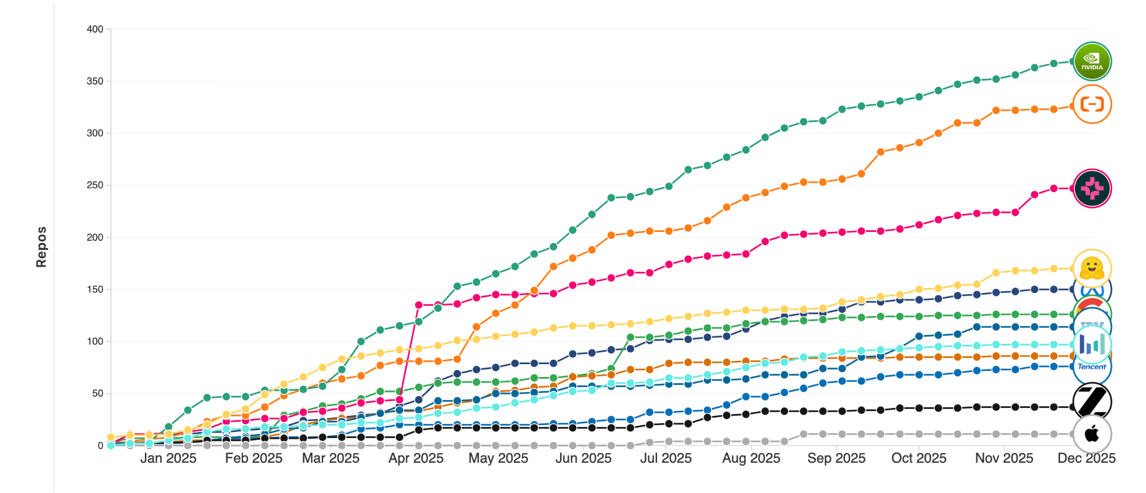
Image 1. Growth of repositories across major open model families on HuggingFace (2025). Source: Hugging Face.
Open Models in Action
Open models contribute to AI development in two complementary ways: enabling entirely new AI systems to be built and improving the performance of existing ones.
Open datasets, such as Nemotron’s approximately 10 million training tokens, enable organizations to develop entirely new AI models by building on foundations instead of starting from the ground up. According to NVIDIA, Sakana AI developed its Fugu and Fugu-Ultra models using Nemotron 3 Ultra, demonstrating how open models can accelerate the creation of new AI.
Beyond reducing development effort, this approach also enables organizations to focus resources on solving industry- or region-specific challenges, leading to more specialized AI applications and faster innovation cycles. Open models facilitate continuous improvement of existing AI systems through fine-tuning and community-driven development. Open model weights and source code allow researchers and developers to identify limitations, contribute improvements, and optimize models for specific use cases. This collaborative development process enables innovations to be shared across the broader AI ecosystem.
This can be seen in NVIDIA’s own Nemotron iterations, where Nemotron 3 Nano achieved higher accuracy while activating fewer parameters than previous generations. Continuous refinement leads to improved accuracy, higher reasoning benchmark scores, and lower inference costs.
AI Progress Is a Collective Effort
As more organizations contribute models, datasets, and improvements back to the community, they create a cycle in which AI systems become more capable, efficient, and specialized over time.
FPT’s own Nemotron-Personas-Vietnam dataset reflects this broader industry trend. By contributing localized, open data, it supports the development of Vietnam-specific AI applications while helping improve future generations of AI models.
Looking ahead, organizations should consider how they can build upon open models to create more capable and specialized AI applications.
References
[1] https://blogs.nvidia.com/blog/open-models-icml-2026/
[2] https://www.youtube.com/watch?v=Oojrfdl42LI
[3] https://hai.stanford.edu/assets/files/ai_index_report_2026.pdf
[4] https://huggingface.co/blog/huggingface/state-of-os-hf-spring-2026