
B200 vs B300 is no longer just a spec comparison. For most teams, the real question is which Blackwell GPU better matches workload size, performance targets, and infrastructure readiness. In this article, FPT AI Factory breaks down the differences between B200 and B300 across compute, memory, power, and deployment fit.
1. What are the B200 vs B300 GPUs?
B200 vs B300 are NVIDIA Blackwell GPUs built for AI training, AI inference, and high-performance computing (HPC). While both belong to the Blackwell generation, they are designed for different workload profiles.
- B200 is a Blackwell GPU built for enterprise AI workloads that need strong performance for training and inference, while keeping deployment more practical for a wider range of data center environments.
- B300 is a more advanced Blackwell GPU designed for larger and more demanding workloads, with stronger positioning for memory-intensive AI, large-model inference, and advanced HPC use cases.
Overall, B200 is often the more practical starting point for many AI teams, while B300 is better suited to organizations that need higher performance for more demanding workloads.
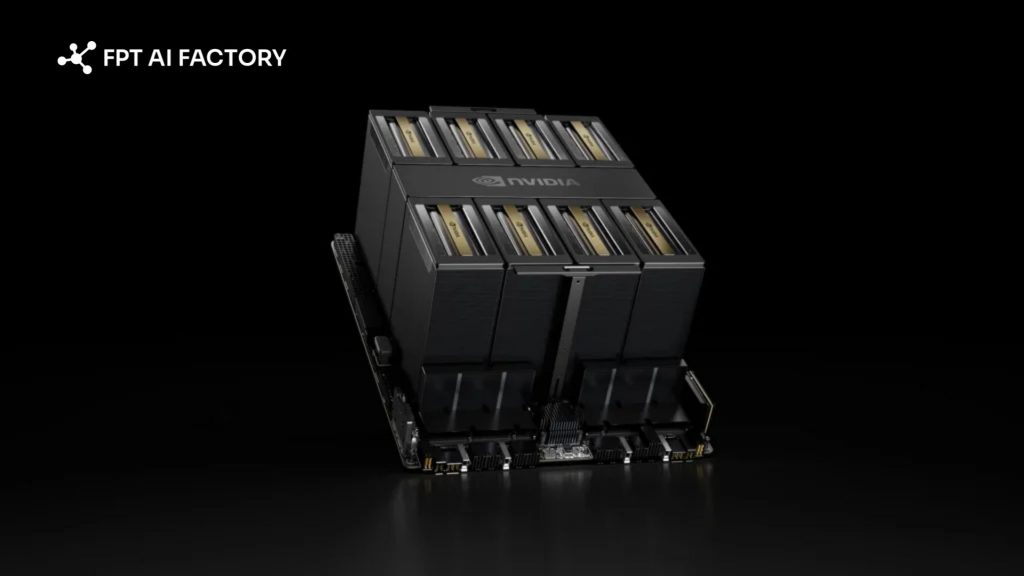
B200 and B300 are NVIDIA Blackwell GPUs for AI and HPC workloads (Source: FPT AI Factory)
2. B200 vs B300: Key Differences at a Glance
When comparing B200 vs B300, the main differences come down to memory, performance headroom, and infrastructure demand. B200 is the more balanced option for many enterprise AI workloads, while B300 is better suited to larger and more demanding deployments.
| Feature | B200 | B300 |
| Architecture | Blackwell GPU for enterprise AI workloads | Blackwell Ultra GPU for larger-scale AI and HPC |
| Compute performance | Strong performance for AI training and inference | Higher performance headroom for larger and heavier workloads |
| Memory capacity | 192 GB HBM3e, suitable for many current enterprise AI use cases | 288 GB HBM3e, better for larger models and longer context workloads |
| Infrastructure demand | Best suited to mainstream large-scale AI deployment | Better suited to memory-heavy AI, advanced reasoning, and mixed AI/HPC workloads |
| Infrastructure demand | More practical for broader deployment | Requires more advanced power and cooling readiness |
| Best fit for workloads | You need strong Blackwell performance with a more balanced rollout path | You need more memory, higher performance, and room for more demanding workloads |
3. B200 vs B300: Specs and Performance
3.1. Compute Performance
The B300 delivers roughly 30–35% higher peak throughput than the B200 across FP4, FP8, and INT8 precision formats. For FP64, the precision standard for scientific and engineering workloads, the gap is even wider, with the B300 pulling ahead in double-precision math that HPC pipelines depend on.
That said, the B200 is no slouch. At FP8, it handles trillion-parameter model training effectively, and its FP4 support allows dense quantized inference that rivals previous-generation hardware at a fraction of the cost per token. For most production AI deployments today, the B200 already exceeds what teams can fully utilize.
The B300’s compute advantage becomes meaningful when running multiple large models simultaneously, training models above the 400–500 billion parameter range, or running tight-latency inference under heavy concurrency.
Compute performance between B200 and B300 (Source: Freepik)
3.2. Memory and Bandwidth
This is where the B300 most clearly separates itself. With 288 GB of HBM3e memory versus the B200’s 192 GB, the B300 can load significantly larger model weights without offloading to system memory — a bottleneck that silently degrades performance in large-scale inference.
Memory bandwidth follows the same pattern: 10 TB/s on the B300 versus 8 TB/s on the B200. In attention-heavy transformer workloads, bandwidth often constrains throughput more than raw FLOPS. A wider memory bus means faster data movement between GPU cores and memory, directly improving tokens-per-second on long-context models.
For teams running models that fit comfortably within 192 GB — including most 70B and many 180B parameter models — the B200’s memory is sufficient, and the cost delta from upgrading to a B300 may not justify the performance gain.
3.3. Power and Cooling Requirements
The B200’s ~1,000W TDP makes it compatible with many existing data center designs, particularly those already running A100 or H100 clusters. Standard air cooling can handle it in well-configured racks.
The B300, at ~1,400W, requires liquid cooling in most configurations. Retrofitting a facility for liquid cooling is a non-trivial investment – it affects rack design, power distribution units, facility cooling capacity, and maintenance protocols. Organizations without existing liquid cooling infrastructure should factor this into total cost of ownership before committing to a B300 deployment.
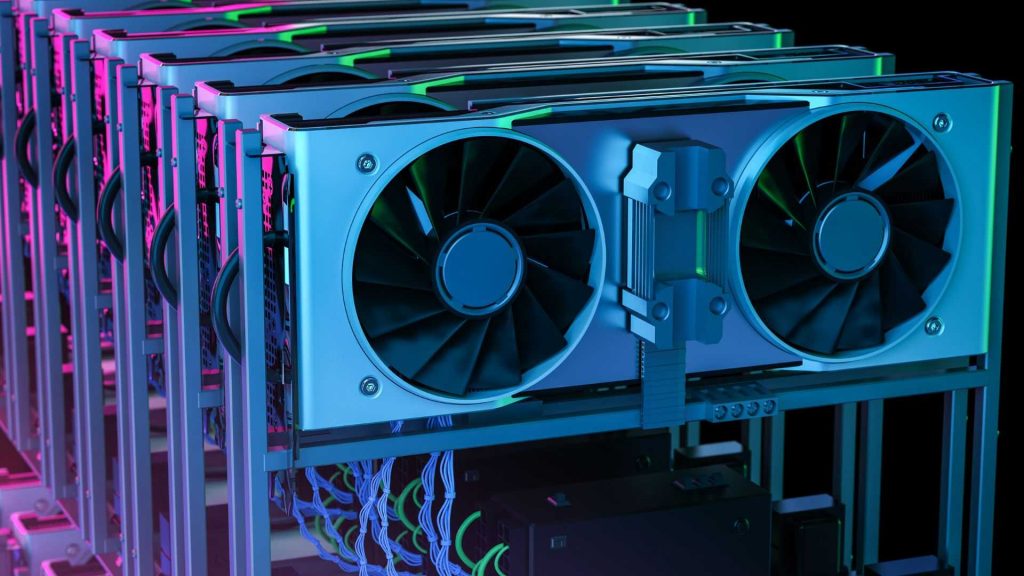
Power and Cooling Requirements (Source: Freepik)
4. B200 vs B300 for Different Workloads
4.1. AI Training and Inference
For training large language models (LLMs) and diffusion models, both GPUs are competitive. The B200 handles most current training jobs – including GPT-class models up to several hundred billion parameters, with strong throughput and reasonable power draw.
The B300’s larger memory and higher bandwidth pay off when training runs require holding bigger activation tensors or when gradient accumulation strategies push memory limits. Multi-node training that uses NVLink and NVSwitch also benefits from the B300’s higher inter-GPU bandwidth.
For inference, the choice depends on batch size and model size. Serving a 70B model at moderate concurrency? The B200 handles it well. Serving a mixture-of-experts model with a trillion-plus total parameters at high concurrency? The B300’s memory capacity prevents the performance degradation that comes from model sharding across too many GPUs.
Businesses that need to deploy AI training and inference quickly – without building or managing on-premise GPU infrastructure – can use GPU Virtual Machine from FPT AI Factory. This cloud deployment option gives teams immediate access to high-performance GPU compute, making it practical to start workloads within hours rather than months.
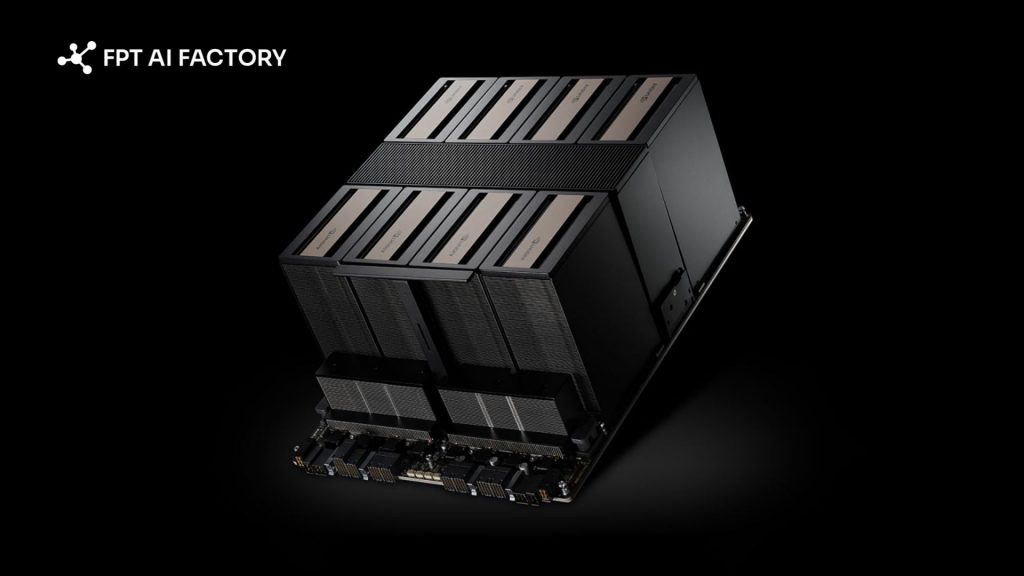
NVIDIA HGX B300 (Source: NVIDIA)
4.2. HPC and Scientific Computing
HPC workloads such as molecular dynamics, finite element analysis, climate modeling, and computational fluid dynamics rely heavily on FP64 precision. Here, the B300 has a clear advantage. Its higher double-precision throughput means shorter time-to-result for simulation runs that may take days or weeks at scale.
The B200 is still a capable HPC GPU – significantly better than the H100 at FP64 – but research teams running computationally intensive simulations will find the B300’s performance gap worth the infrastructure investment, particularly in academic and national lab environments where job queue times are a real operational constraint.
4.3. Quantized Inference and INT8 Workloads
Quantized inference – deploying models at INT8 or FP4 precision to reduce latency and cost – is one of the most common production AI use cases. Both the B200 and B300 support these formats natively, and the performance difference between them is proportional to the broader compute gap.
For inference-at-scale deployments where the goal is minimizing cost per query, the B200 may actually offer better economics: lower hardware cost, lower power draw, and sufficient throughput for most production traffic levels. The B300 is the right call when inference workloads are extreme – serving very large models, handling very high request volumes, or maintaining strict latency SLAs under load.

Quantized Inference and INT8 Workloads (Source: NVIDIA)
5. How to choose between B200 and B300
B200 and B300 are both built for large-scale AI, but they fit different deployment priorities. In practice, B200 is a strong choice for teams that need high-performance training and inference on a more established Blackwell platform, while B300 is better suited to reasoning-heavy and memory-intensive workloads that need higher throughput and larger memory headroom.
| Use case | Choose B200 | Choose B300 |
| Enterprise AI workloads | A solid choice for teams running a mix of training, fine-tuning, and inference workloads. | A better fit for teams prioritizing newer, more demanding AI workloads at larger scale. |
| Large language model serving | Suitable for production LLM deployment with strong overall performance and flexibility. | Better for higher-throughput LLM serving, especially for heavier reasoning-focused workloads. |
| Memory-heavy model deployment | Works well when current model size and context requirements are already well defined. | More suitable when models require more memory headroom or longer-context support. |
| Infrastructure build-out | A practical option for organizations deploying Blackwell infrastructure now. | A stronger option for teams planning around future growth and more intensive AI demand. |
| Long-term platform strategy | Best for teams that want a capable baseline for current AI operations. | Best for teams investing in next-stage AI capacity and more advanced inference needs. |
FPT AI Factory is expanding its GPU portfolio and will soon offer B300-based services for teams ready to take on the most demanding frontier AI and HPC workloads. If you want to get started now or be among the first to access B300 compute, reach out to our team.
The B200 vs B300 decision is ultimately about matching GPU capability to real workload requirements – and balancing that against infrastructure readiness. The B200 is the more accessible, cost-efficient choice for a wide range of AI training and inference tasks. The B300 is the right tool when memory capacity, bandwidth, or FP64 throughput becomes the limiting factor.
6. FAQs
6.1. What is the difference between HGX B300 and B200?
HGX B300 is generally designed for larger and more demanding AI workloads, offering higher memory capacity and stronger performance headroom than HGX B200. In comparison, HGX B200 is often positioned as a more balanced Blackwell platform for enterprise AI training, inference, and broader deployment scenarios.
6.2. What’s the difference between B300 and GB300?
B300 typically refers to the standalone Blackwell Ultra GPU, while GB300 usually refers to a Grace Blackwell platform that combines NVIDIA Grace CPUs with Blackwell GPUs in a tightly integrated architecture. In simple terms, B300 is the GPU itself, whereas GB300 is a larger compute platform built around it.
6.3. Is the B300 Blackwell Ultra?
Yes, the B300 is commonly described as part of NVIDIA’s Blackwell Ultra generation. Compared with the standard B200, the B300 is generally associated with higher AI throughput, larger HBM memory capacity, and stronger support for advanced AI reasoning and HPC workloads.
>> Read more:
A100 vs H100: Which GPU is better for AI workloads?
NVIDIA H100 vs H200: Key GPU differences and AI power
NVIDIA H100 GPU: Specs and Reasons for AI Performance
Cloud GPU Pricing in 2026: What It Costs and How to Choose
Contact Information:
- Hotline: 1900 638 399
- Email: support@fptcloud.com